
Easy signals break the web
Fake accounts, fake reviews, and spam can be programmatically generated at low cost and with no consequence for the attacker.
Chronicle turns Bitcoin into verifiable signals that help clients filter noise, surface credibility and build a calmer, safer web.

 Why Chronicle?
Fake reviews. Mass manipulation. AI bots. Synthetic content. Cyberattacks. All these stem from one common cause: online action is cheap and actors’s don’t bear the consequences. Explore how Chronicle addresses this problem.
Fake accounts, fake reviews, and spam can be programmatically generated at low cost and with no consequence for the attacker.
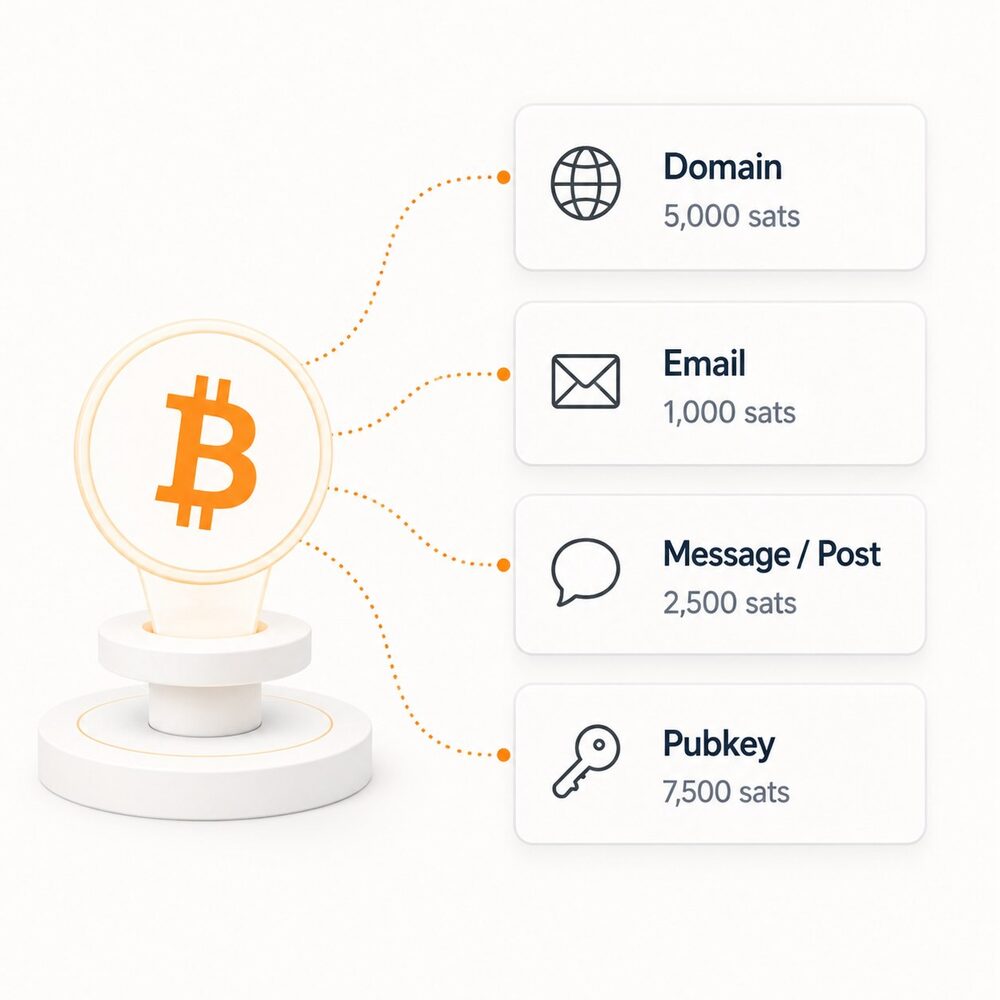
Real cost and accountable identity are attached to pubkeys, messages, reviews, and other signals, giving them real weight and accountability.
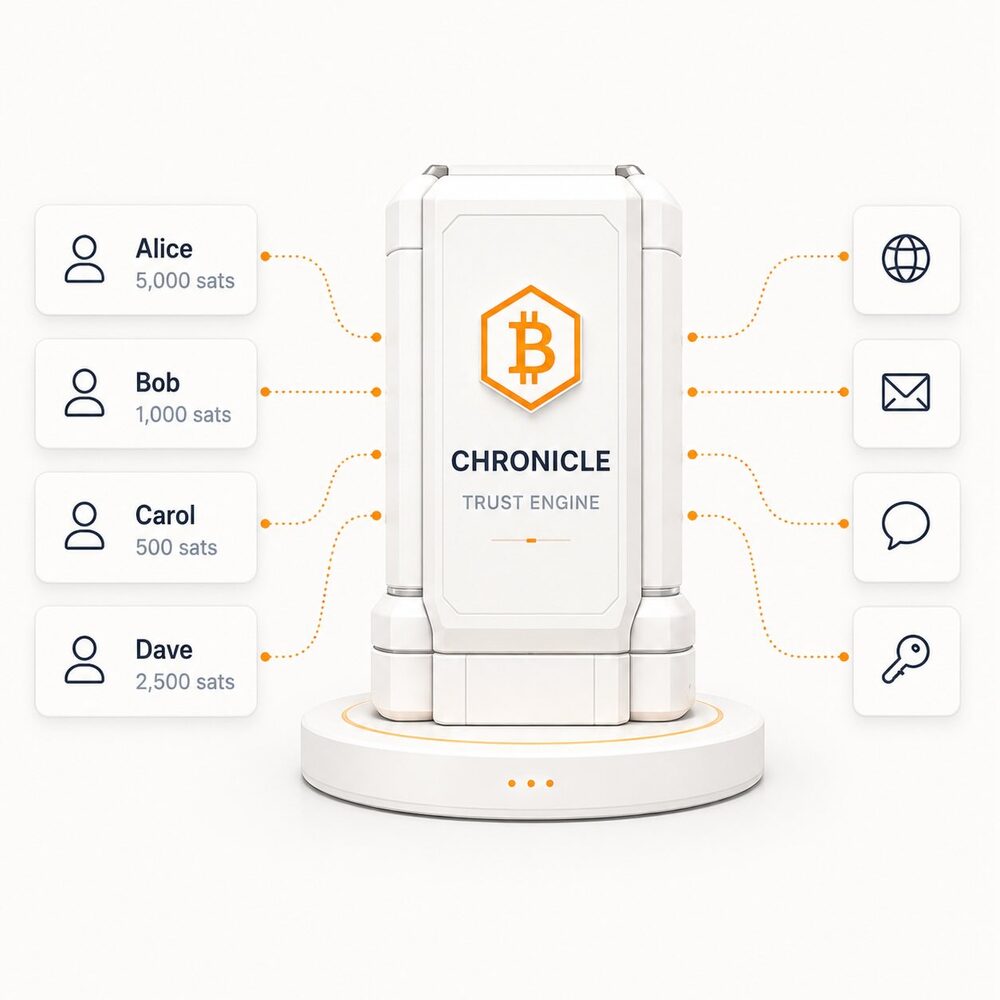
Hard signals are batched, anchored and stored in a persistent public memory that everyone can read and verify.
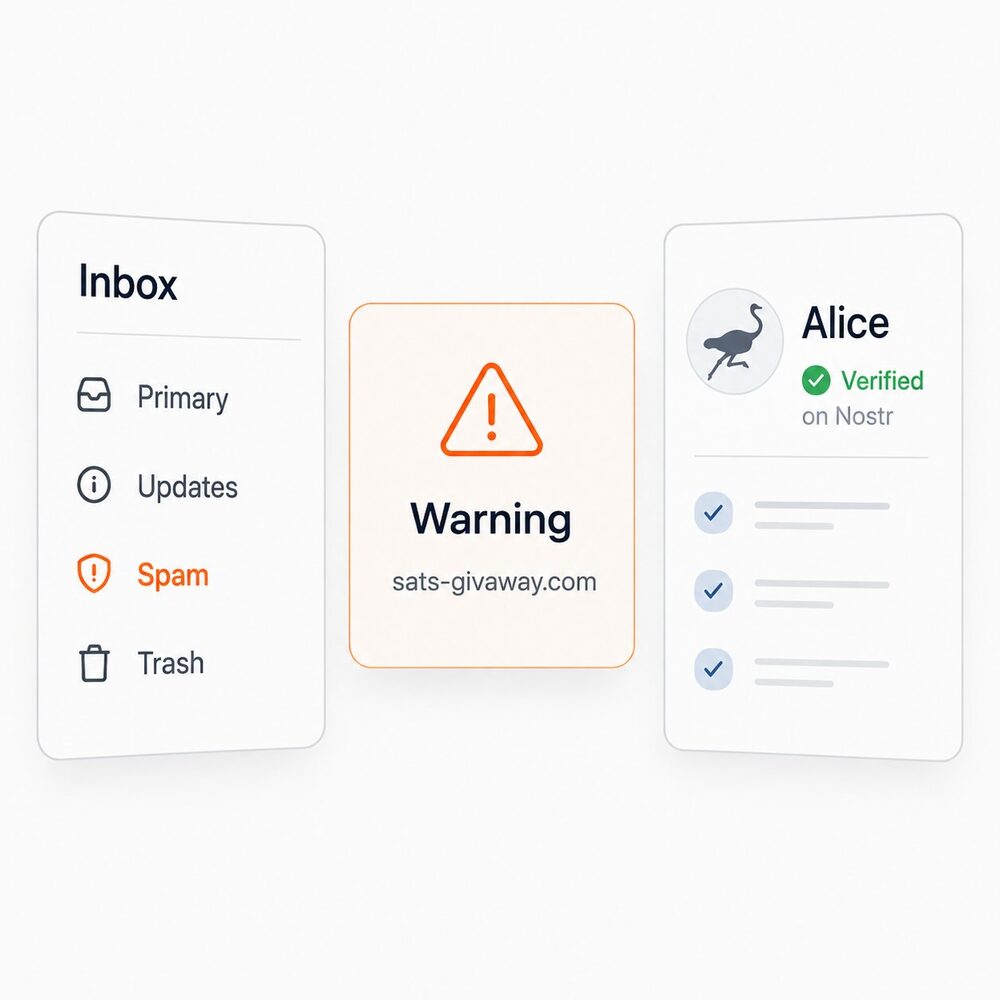
Inboxes, browsers, social media, and other clients can consult the public record to filter spam, warn against scam and surface credibile content.

When signals can no longer be produced at low cost and without accountability, the game begins to favor the honest player.
Use cases
Chronicle’s primitive is simple: a hard signal that attaches cost and credibility to information. But its emergent properties enable many powerful use cases.

Share attack signals across servers, so one defender’s warning can help protect the rest.
Learn more
Trade directly when the other party has more credibility to lose than money to gain.
Learn more
Give online conduct a memory, so trolls lose more than a disposable account.
Learn more
A clean, spam-free inbox where senders prove credibility or cost.
Learn more
See who stands behind a domain, and what they put at risk before trusting it.
Learn more
Match a mint’s credibility to the amount of Bitcoin you are willing to risk.
Learn moreFormal model

If praxeology, mathematics, and metaphysics had a child, it might look like this framework.
We're developing a kind of “social physics” for studying subjective phenomena like trust in a mathematically rigorous way. Trust can be modeled and engineered, and Chronicle is the first practical application of this process.
The work is early, but parts of the research are already published.
Chronicle is under active R&D. We're developing the protocol, reputation algorithms, UX patterns, mathematical models and simulations needed to understand the system before wider deployment.
If you’d like to work on rearchitecting the internet, participate in early experiments, fund or support the project, please get in touch.
Chronicle is a general-purpose proof-of-cost protocol with persistent public memory. Think of Hashcash that remembers who spent what cost, what they spent it on, and what happened next.
The protocol is intentionally small. At its core is a signed, cost-bearing event:
[kind, subject, amount, pubkey, created_at, sig]
Each event records an action. Its kind
defines how the subject
and amount
are interpreted: endorsing or opposing a domain, backing an email message, verifying a domain,
linking pubkeys, cancelling a prior action, and other actions defined in the registry.
Start with the README for the plain-language explanation of the system.
CIP-01 is the protocol specification. It defines how clients authenticate and publish events, how nodes charge and relay them in real time, and how events are batched and their aggregate cost anchored to Bitcoin.
The registry defines the individual event kinds: what each action means, what subject it refers to, and how its amount is interpreted.
The whitepaper provides broader research context around incentives, reputation, and the larger technical model. CIP-01 and the registry are the current protocol references.
Chronicle is ready for small-scale experimentation, but remains under active R&D and is not ready for production deployment.
FAQ